NTT West and Iris Ohyama Validate AI Platform for Multi-robot Coordination
Osaka-based NTT West and Iris Ohyama demonstrated successful integration of cleaning robots, humanoids, and facility systems through a physical AI platform, proving technical feasibility for unified facility management.
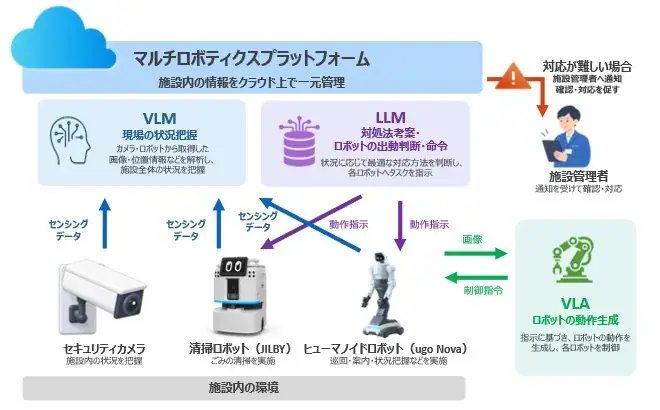
OSAKA: NTT West and Iris Ohyama have validated a physical AI platform that links robots from different makers to existing facility systems. In the demonstration, cleaning robots, humanoid units, security cameras and elevators worked together through vision-language AI models.
The proof-of-concept follows an October 2025 partnership agreement between NTT West, which is headquartered in Osaka, and Iris Ohyama, which is based in Miyagi Prefecture. The Multi-Robotics Platform uses three AI components: a Vision-Language Action (VLA) model, a Vision-Language Model (VLM) and a Large Language Model (LLM). Together, they let different robots and building systems share information and divide tasks on their own.
In the demonstrations, the VLM analyzed security camera footage. The LLM issued instructions to Iris Ohyama’s JILBY cleaning robot. It also coordinated task-sharing between JILBY and ugo’s Nova humanoid robot. The VLA let the robots adjust their behavior to surrounding conditions, without human input.
The two companies will show separate functions at four trade shows from November 18 to December 11. The events take place at NTT’s Musashino R&D Center and at Tokyo Big Sight. They include NTT R&D FORUM, the Building Maintenance Human Fair, Smart Building EXPO and SEMICON Japan. The companies did not disclose a commercial deployment timeline or budget.
Facility management in Japan is still split across vendor systems that do not work together. A coordination layer that works across brands addresses a core barrier to robot adoption. That matters most in cleaning, security and logistics, where labor shortages are acute. The next milestone is the end of the demonstrations on December 11.