Kyoto University Diamond Sensor Boosts Dark Matter Detection Sensitivity Tenfold
Researchers at Kyoto University demonstrated that quantum three-level systems in diamond nitrogen-vacancy centers can improve axion dark matter detection sensitivity by up to 10× over conventional qubit methods.
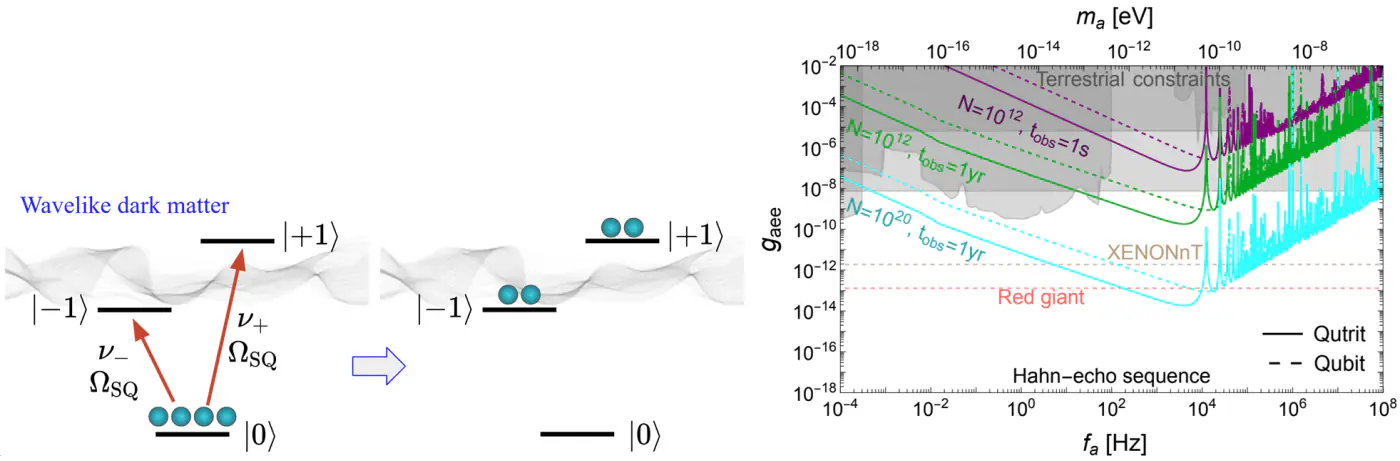
KYOTO — A collaboration led by Kyoto University researchers has shown that diamond-based quantum sensors using three-level systems can detect dark matter candidates up to ten times more sensitively than existing two-level quantum bit methods, according to work published in June in Physical Review A.
The team exploited the spin triplet state of nitrogen-vacancy (NV) centers in diamond — defects that act as atomic-scale magnetic sensors — as “qutrits” rather than conventional qubits. Applying this approach to searches for axion particles, a leading dark matter candidate, yielded roughly one order of magnitude improvement in sensitivity to axion-electron coupling across a broad mass range. Previous NV-center methods had not fully harnessed the quantum mechanical properties of these defects.
Why it matters: Diamond quantum sensors are already deployed in precision metrology; this advance positions them as practical tools for fundamental physics experiments that require detecting extraordinarily faint signals. Kyoto University’s Spintronics Research and Education Center, which contributed experimental implementation expertise through Prof. Norikazu Mizuochi, anchors one of Japan’s leading programs in diamond sensor development.