Medical AI Startup Direava Wins CEATEC Award for Surgical AI That Explains Operations in Real Time
Direava's Surgical VLM, a vision-language AI model that analyzes endoscopic surgery footage and generates natural language explanations of surgical context, achieved 84.7% anatomical accuracy in operating room trials and won CEATEC 2026's Innovation Prize.
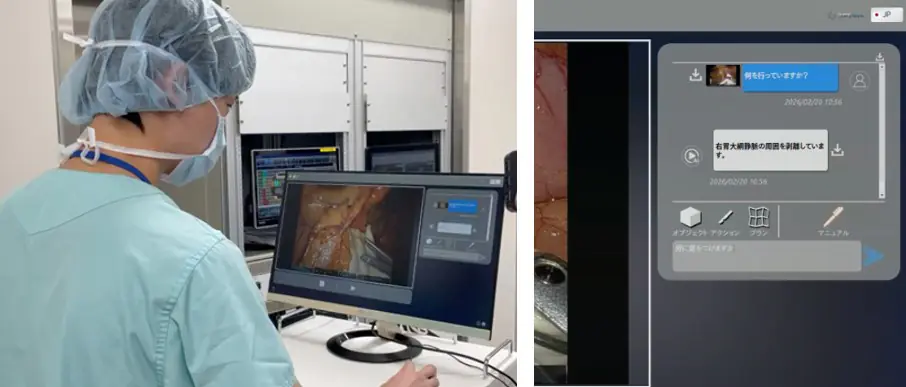
TOKYO — Medical AI startup Direava won the Innovation Prize at CEATEC AWARD 2026 for a surgical foundation model that interprets endoscopic surgery footage and explains what is happening in natural language, the first such system deployed in Japanese operating rooms.
The Surgical VLM (Vision-Language Model), developed under NEDO’s GENIAC program starting August 2025, achieved 84.7% anatomical accuracy and 82.9% clinical utility in real-time trials at university hospital operating rooms, as rated by surgical specialists using a proprietary benchmark. Unlike prior surgical AI that identifies organs and vessels, this model adds a reasoning layer: it categorizes what it sees into object, action, clinical rationale, and next step, then generates structured Japanese explanations.
Direava CEO Yushi Takeuchi said the system addresses looming shortages: digestive surgeons are projected to halve over 20 years, leaving a 5,000 physician gap by 2040. The company will launch first as a training tool for junior surgeons and medical students, then pursue regulatory clearance for intraoperative decision support.
Japan has strong endoscopy hardware but lags in surgical AI software; a domestic foundation model reaching 80%-plus clinical validation shows Kansai deeptech can compete in regulated medical verticals. Direava secured a second GENIAC grant in June 2026 to build predictive surgery models. The technology will be exhibited at CEATEC 2026, October 13–16 at Makuhari Messe.